

You open your phone “for a second” and end up scrolling without really looking at anything.
You switch between apps, check messages, maybe start something, then drop it.
Or you sit down to rest, but instead of actually relaxing, you just feel… restless.
Not productive, not fully relaxed either.
So you end up doing something that takes almost no effort – scrolling, snacking, binge watching.
That in-between state is your nervous system staying slightly activated.
Vagus nerve exercises help shift you out of that state and finally feel a sense of lightness and calm.
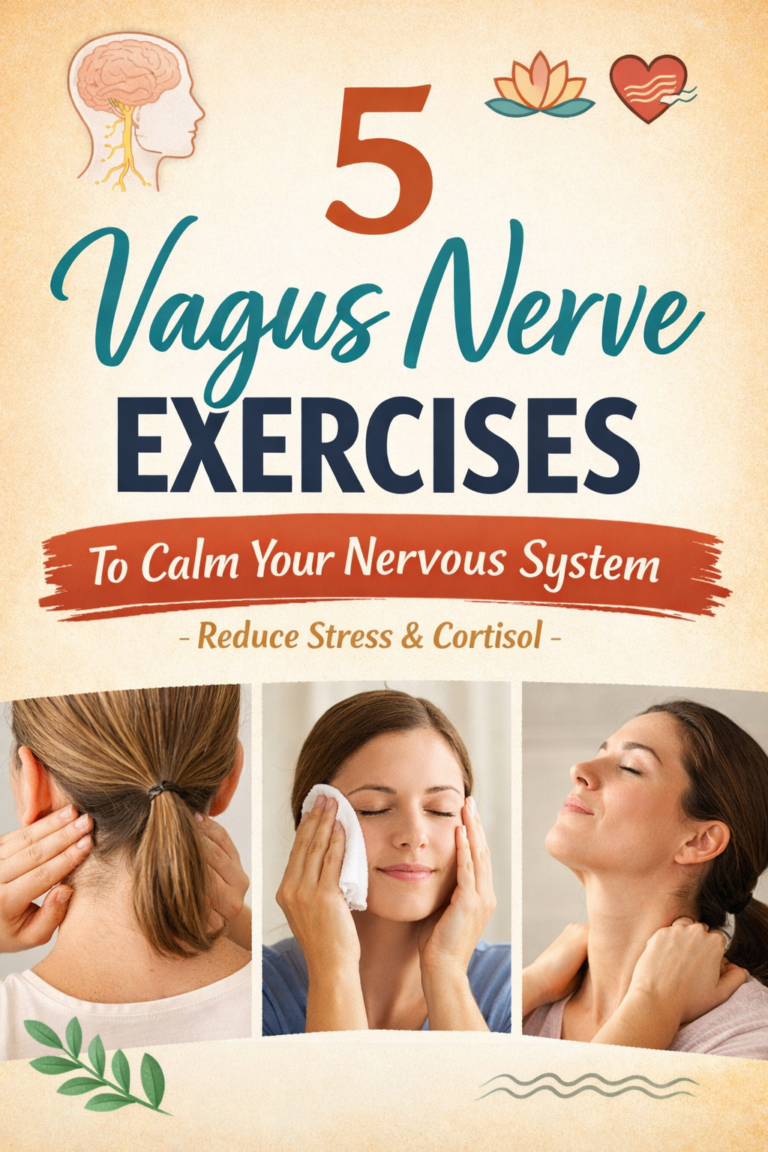
What Is the Vagus Nerve?
The vagus nerve is a long nerve that runs from your brain down through your neck and into your chest and abdomen.
It connects your brain to key systems in your body: like your heart, lungs, and digestion. It helps regulate how “on” or “off” your body feels.

Think of it as part of your body’s brake system.
When it’s working well, it helps slow things down:
- Your heart rate settles
- Your breathing becomes more steady
- Your body stops preparing for the next thing
When it’s not very active, your system stays in “go mode”- even when there’s no real reason to be.
Vagus nerve exercises help activate that braking system so your body can actually shift out of that constant low-level alert.
Why Your Nervous System Feels Overwhelmed
It’s not just big stress that keeps your system activated. It’s the way your day is structured.
Most of the time, there’s no clear “stop” point.
You move from one thing to another:
- Work → phone → messages → something else
- One tab to the next
- One task interrupted by another
Even when you take a break, it usually looks like more input, like scrolling, watching, checking something.
So your brain never really gets the signal that it can fully switch off.
Instead, it stays in a low-level “ready” mode:
- Half-focused
- Easily distracted
- Slightly restless
Not intense stress, but not relaxed either.
If you’ve ever felt overwhelmed, but then actually looked at what you had to do and realized there wasn’t that much, that’s exactly this.
It’s not coming from your to-do list.
It’s coming from your system staying activated in the background.
In connection to cortisol
You might be wondering why are we even talking about cortisol in an article about the vagus nerve?
Because they’re part of the same system.
Cortisol is a hormone that your body releases when it thinks you need to stay alert. The vagus nerve is part of what helps turn that response off once it’s no longer needed.
In a well-functioning system, this goes up and down throughout the day.
The problem is that for many people, it doesn’t come down easily anymore.
Lowering cortisol isn’t as simple as “relaxing.”
You can sit down, take a break, even distract yourself and still feel like your body hasn’t actually settled.
Over time, when cortisol stays elevated longer than it should, it starts affecting both your body and your mind:
- Sleep feels light or inconsistent
- You feel mentally tired but physically restless
- You rely more on quick, low-effort habits (scrolling, snacking)
- Your baseline feels slightly tense, even on normal days
And the longer this goes on, the harder it becomes for your system to reset on its own.
5 Vagus Nerve Exercises
Most vagus nerve exercises are actually about something very simple: reconnecting with your body.
When you slow down and notice your breath, your voice, or your physical sensations, you’re grounding yourself and that’s what helps your nervous system calm down.
These exercises are just a starting point. The goal isn’t to do them perfectly, but to give your body a different signal than the one it’s been running on all day.
1. Humming or Low Sound
Why it works: The vibration around your throat and chest helps shift your body out of that restless state.
How to do it:
- Inhale normally
- Hum slowly on the exhale
- Keep the sound low and steady
If humming feels awkward, even a quiet “mmm” works.

2. Cold Face Reset
Why it works: It interrupts that loop of constant low-level activation and brings your body back down quickly.
How to do it:
- Splash cold water on your face for 10–20 seconds
- Or hold something cold against your cheeks and eyes
Especially useful when you feel stuck in that “can’t settle” state.
Time: 1–2 minutes
3. Vagus Nerve Self-Massage
Why it works: Gentle pressure around the neck and ears can stimulate areas where the vagus nerve runs, helping your body shift out of alert mode.
How to do it:
- Place your fingers just behind your ears, along the side of your neck
- Apply gentle pressure and move in slow, small circles
- Slowly glide your fingers down toward your collarbone
- You can also lightly massage behind the earlobes or along the jaw
Keep the pressure light and the movement slow.
Time: 2–4 minutes
If doing this yourself feels inconsistent or you want something more passive, devices like Pulsetto or Sensate are designed to stimulate the vagus nerve in a similar way, which can make it easier to access that calmer state without effort.
4. Somatic Neck & Shoulder Release
Why it works: Instead of thinking your way out of stress, you’re releasing it where it’s actually held.
How to do it:
- Slowly tilt your head to one side
- Stay there for a few seconds without forcing the stretch
- Roll your shoulders back slowly
- Let your jaw unclench
Keep the movement small. The point is to feel it, not to stretch as far as possible.
Time: 3–5 minutes
5. Visual Reset (Out of Tunnel Vision)
Why it works: Stress narrows your focus. Expanding your vision helps your brain register that nothing urgent is happening.
How to do it:
- Look straight ahead
- Slowly widen your gaze
- Notice what’s around you without focusing on details
Let your eyes soften instead of locking onto one thing.
Time: 2–3 minutes
How Often Should You Do These?
You don’t need a full routine or a perfect schedule.
This works better when you use it in the moment you notice that restless, “in-between” state.
A simple way to approach it:
- Pick one exercise when you feel stuck or unfocused
- Use 1–2 exercises in the evening to actually wind down
- Repeat the ones that feel easiest—not the ones that look best
It’s less about doing all of them, and more about giving your body a different input than what it’s been getting all day.
Quick Daily Reset (3–5 Minutes)
- 1 minute humming
- 1 minute cold face or splash
- 1–2 minutes neck + shoulders or self-massage
Final Note
It’s easy to assume that if you can’t relax, you’re doing something wrong.
But most of the time, it’s not about you. It’s about the pace you’re operating in.
Constant input, switching between things, never fully finishing one state before moving into the next. Your body adjusts to that by staying ready, even during downtime.
That’s why just “taking a break” often doesn’t work.
These exercises give your body a more direct signal to slow down – something the environment around you doesn’t naturally provide.