

For years, my relationship with exercise looked the same: a burst of motivation, intense workouts for a few weeks, and then… nothing.
I would stop, start again months later, and repeat the cycle.
Until I gave up altogether and surrendered to a REALIZATION:
The only relationship with exercise that actually worth having is turning it into a steady, ongoing part of your life.
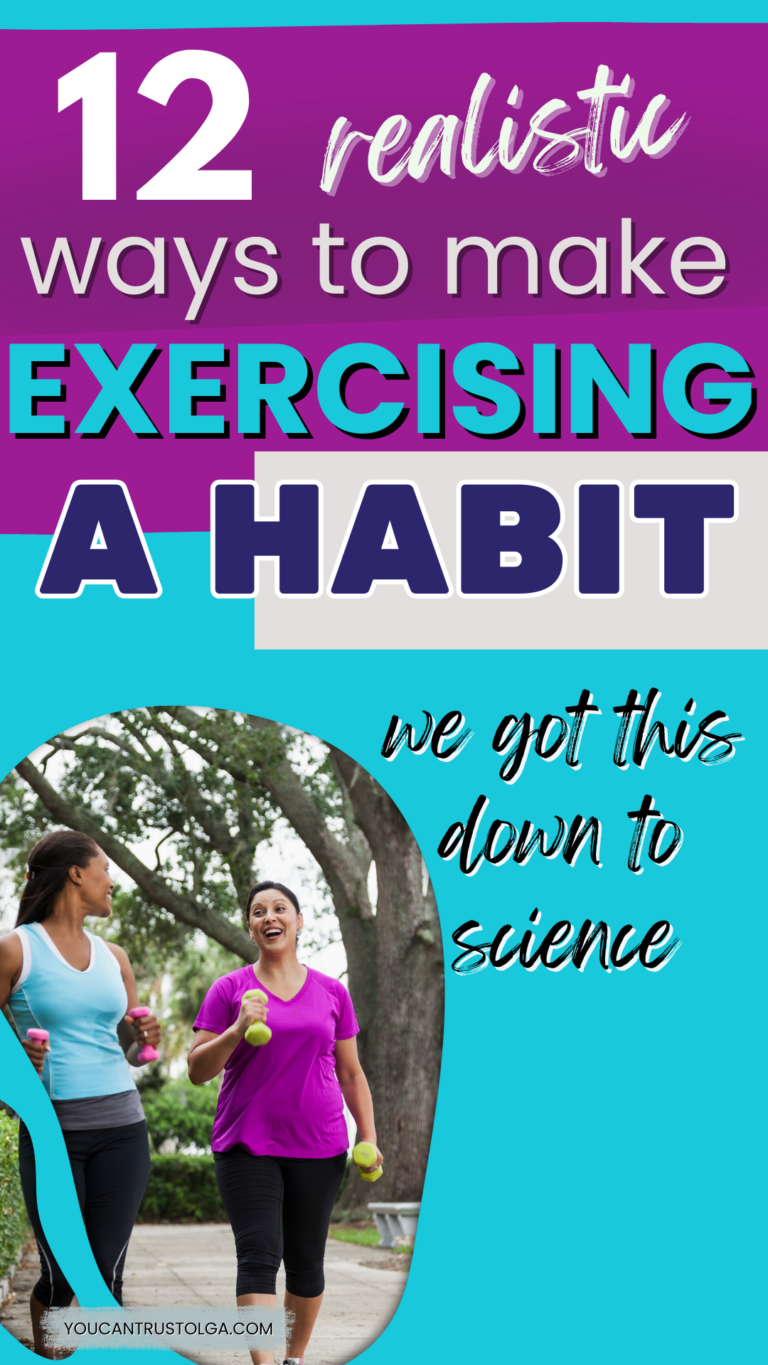
That changed the question from how to start exercising to how to turn it into a sustainable habit.
Once I started thinking about it that way, I began paying closer attention to what actually helped me stay consistent — and what made me fall off track. I also looked into research on habit formation and long-term exercise adherence.
Combining those insights with my own trial and error, I gathered a set of practical ideas that make consistency much easier.
Now, let me share it with you!
1. Know your limits
If exercising doesn’t come naturally to you, but you suddenly feel inspired by a big goal, there’s a good chance you can reach it. Motivation can carry you surprisingly far in the short term.
But the real question is: CAN YOU KEEP THE RESULT?
Because the moment you reach your goal, you can’t press a SAVE button and go back to your normal life. The reality is – now you have to continue doing the same to maintain your results.
If exercise isn’t built into your routine, the result will eventually disappear.
So before you begin again, ask yourself:
HOW MUCH TIME AND EFFORT AM I REALISTICALLY WILLING TO PUT INTO PHYSICAL ACTIVITY?
Not for a few weeks.
But month after month, year after year.
2. Start ridiculously slow

If I could only give you one advice, it would be START SLOW — even ridiculously slow.
When your body isn’t used to movement, doing too much will do more harm than good. It increases the risk of injury and leads to sooner burnout.
So leave your Napoleon-style workout plans behind and be REALISTIC.
You don’t need to attack exercise like it owes you something.
Remind yourself that you are trying to make exercise a consistent, lifelong part of your life. So be PATIENT and don’t scare it away with over-the-top enthusiasm.
3. Do just enough
One of the biggest traps in exercise is thinking you have to do it perfectly — or not at all. Perfectionism is something many of us worship, without realizing how many times it paralyzes us before we even start.
To become more consistent with exercising you will have to change this mentality.
So what if you skip a workout? No problem. You don’t have to wait for Monday, the first of the month, or the New Year. Just do it the next day. Or the day after. The habit continues, even if it’s slightly delayed.
So what you are feeling unmotivated? You don’t have to wait for a surge of energy. Allow yourself to just DO SOMETHING SMALL. Most of times you can talk yourself into five minutes on the treadmill, one set of stairs, a few stretches. That’s enough to keep your routine alive and keep your body moving.
So what you are feeling like you messed up? BETTER SOMETHING THAN NOTHING. Not every session has to be an epic session — every little bit adds up over time.
Approach every workout with a “good enough” mentality. You don’t have to push to your limits or execute every move flawlessly. You just need to show up, do what you can, and STAY CONSISTENT.
Over time, that consistency becomes real progress — without the stress, the pressure, or the burnout.
4. You must enjoy it
You know how some people (usually gym junkies) say they actually enjoy working out? And how that statement can make you cringe a little because it sounds fake. HOW CAN ANYONE IN THEIR SANE MIND ENJOY WORKING OUT?
But then, look at children. They run, play, climb, and stay active for hours, and they genuinely enjoy it. Movement feels natural to them. So why does it become such a struggle for adults?
If you constantly suffer during your workouts or dread them every time they appear on your schedule, you’re simply choosing THE WRONG TYPE OF EXERCISE.

Exercise can give you energy from moving, making you feel better after a workout, and over time it becomes something you are look forward to.
But it’s only true when you find a type of movement that FITS YOU.
So instead of forcing yourself into workouts you hate, focus on finding something you actually like — or at least something you don’t mind doing regularly.
When adapting exercise to your personal interests, ask yourself a few questions:
Do I prefer exercising inside or outside?
Do I enjoy working out alone or around other people?
How far am I realistically willing to travel for workouts?
Do I like group classes?
Think a little outside the box and be creative.
Examples of physical activities you can try
| Category | Activity Ideas |
|---|---|
| Walking & Cardio | Walking, hiking, jogging (outdoors or treadmill), brisk neighborhood walks |
| Cycling | Biking alone, group cycling, indoor cycling classes |
| Water Activities | Swimming laps, ocean/lake swimming, kayaking, paddle-boarding |
| Sports & Games | Tennis, soccer, basketball, football, recreational sports |
| Gym-Based Training | Weight lifting, strength training machines |
| Short Home Workouts | 10–30 minute YouTube workouts, quick daily routines |
| Group Classes | Yoga, Pilates, spin/cycling classes, fitness studios |
| Dance-Based Movement | Zumba, Latin dance, hip-hop classes |
| Outdoor Fitness | Park workouts, beach workouts, outdoor fitness circuits |
| Wheeled Activities | Rollerblading, skateboarding |
| Seasonal Sports | Skiing, snowboarding |
| Somatic & Gentle Movement | Somatic exercises, mobility routines, body awareness movement, gentle stretching |
| Stair Workouts | Walking or running stairs, step-ups, quick stair cardio sessions |
| Micro-Workouts | 5–10 minute movement breaks during the day |
| Everyday Movement | Walking while taking phone calls, stretching while watching TV |
| Play-Based Movement | Playing with kids, frisbee in the park, casual backyard games |
| Active Commuting | Walking or biking for errands instead of driving |
5. Make your workout short
To exercise consistently, it’s better to choose regularity over intensity. Shorter but more frequent workouts tend to be more effective in the long run and much easier to sustain.
It’s also easier psychologically to agree to a short session. Committing to 20 minutes feels very different from committing to a full hour.
For example, my workouts usually don’t exceed 20–30 minutes. Because they’re short, it’s much easier for me to do them regularly.
That simple shift, negotiating with myself to do short but frequent workouts is what finally helped me make exercise a SUSTAINABLE part of my life and start moving every day.
6. No more overexercising

I remember once going to a very intense group class. Because of the instructor and the pressure of everyone around me, I pushed myself far beyond my limits.
Yes, at the end of the class I felt proud. Accomplished, even. But when the same class showed up on my schedule the following week, all I could remember was how painful it felt.
There was absolutely no chances I’d go back and repeat that experience.
The point?
You might think that pushing yourself harder should give you better results. But how has that approach actually worked out for you in the past?
The brain is very quick to connect exercise with pain. And once that association is formed, it will naturally start resisting anything that reminds it of that experience.
And even if you have strong willpower, how long can you realistically maintain the kind of boot-camp intensity you forced on yourself?
7. Keep it flexible
Very often, you’ll see advice to schedule your workouts ahead of time and follow that plan strictly. While this approach works for some people, for many others it can become too rigid.
When exercise is tied to a strict schedule, it’s much easier to drop it altogether. Miss the planned time slot, and suddenly the whole workout feels “ruined.”
Instead, try approaching exercise a little more INTUITIVELY. In other words, allow some flexibility and be willing to adjust your workouts depending on how your day actually unfolds.
When you are more flexible, it means that:
You don’t have to skip the whole day just because you missed a certain window.
You can adjust your workout session depending on the structure of each day.
You listen to your body and become more in tune with its natural need for movement.
8. Stop comparing yourself
If you want physical activity to stay your good friend for many years, you need to learn how to forgive yourself for your weaknesses.
As counterintuitive as it may sound, accepting yourself as you are is often the most direct path to real growth and improvement.
You may admire fitness influencers — their discipline, perseverance, and dedication.
But you also have to recognize that you are a different person. You may not have the same personality, lifestyle, or priorities, and that’s completely okay. After all, they are not you either.
Once you start understanding who you are and where your real limits are, it becomes much easier to figure out what, how, and when exercise will actually work for you.
9. Don't overcomplicate
Making a strategic plan, hunting for the perfect workout routine, scouting the latest gear, or following fitness influencers — all of this is often just a form of PROCRASTINATION.
It creates unnecessary tension around something that’s actually simple and accessible.
Exercising doesn’t have to be complicated.
You don’t need anyone or anything to get started today.
You don’t need a plan.
You just need ACTION.
10. Trick yourself
Almost always, the hardest part of a workout is just getting yourself to go. Pushing too hard often creates more resistance. But tricking yourself into starting?
That can actually work.
Often, all you need to get moving is a gentle, encouraging talk with yourself.
Here’s what I do when I feel resistant:
I tell myself, “Today, I’m only going to walk on the treadmill for five minutes.” Something is always better than nothing. I also give myself honest permission to leave whenever I want.
Most of the time, I end up finding enough energy to stay for the full workout. Sometimes I leave after five minutes — AND THAT’S OK.
It happens rarely, but even those small sessions count toward building a consistent habit.
11. Remind yourself of benefits
People often say that motivation doesn't last. Well, neither does bathing – that's why we recommend it daily.
Exercise to lose weight is only one of many reasons we move our bodies. Staying physically active does wonders not just for appearance, but also for health, energy, and mood.
Keeping the countless benefits in mind CAN and WILL motivate you.
One of the biggest motivators for me is how I feel afterward. Being prone to anxiety and panic attacks, I almost forgot about them once I started exercising CONSISTENTLY.
When exercising is just at the stage of habit-formation, it’s important to remind yourself WHY you are doing this.
As Friedrich Nietzsche once said, “He who has a why to live can bear almost any how.” The same goes for exercise: when your reason is clear, you can push past obstacles, excuses, and resistance.
In other words, when you know your “why,” the “how” becomes much easier.
12. Get a friend on board
For many people, a great way to start exercising is to bring someone along for the ride. Make it more fun and motivating by committing to a once-a-week workout with a friend.
Pick a day and time and turn it into a small ritual for the two of you. It could be a Tuesday night cycling class or Sunday morning yoga followed by brunch. Put it in your schedule and treat it as a priority.
Having another person’s interests involved makes it much easier to show up consistently.
FINAL THOUGHTS
As you see, making exercise part of your life isn’t about willpower or chasing perfection. It’s about shifting your mindset.
You don’t need to suffer, overplan, or try to become someone you’re not. You just need to be honest about what you can stick with, what feels good, and what actually fits into your life.
The goal isn’t to be extreme, it’s to be consistent. Once you stop overthinking and just start moving, you’ll see it’s not nearly as complicated as it seems.
You’ve got this. Start small, keep it realistic, and watch the habit grow.